
Every nursery manager knows the sinking feeling. A practitioner knocks on the office door, closes it behind her, and says, “Have you got a minute?” Before she says another word, you know. She’s leaving.
And when she goes, she takes far more than her hours on the rota. She takes the trust of the children in her key group, the relationships she built with their families, and everything she knew about how the room works. The children feel it first. Then the team. Then the families.
Early years has been losing good people for years. Some leave for better pay, and nobody can blame them. But many leave for reasons that have little to do with money. They leave because they feel unsupported, unheard, worn out or unsure they are any good at their job. And those are reasons that leaders can do something about.
Leadership is not paperwork
I have led schools and nurseries for more than forty years, and I have inspected many more. Let me tell you what I learned: the quality of a setting almost never rises above the quality of its leadership. Not because leaders do all the work, but because leaders create the conditions in which everyone else does theirs.
Too much of nursery leadership has become about compliance: rotas, ratios, policies, audits, inspections. All of it matters. But none of it, on its own, will make a tired practitioner want to come back on Monday morning.
What makes people stay is something quieter, and far more powerful.
What makes people stay
In my experience, practitioners stay where three things are true.
They know their work matters. Not in a poster-on-the-staffroom-wall way, but because someone tells them, specifically and often. “I saw how you settled Amira this morning. That was skilled work.” Those few words can carry a practitioner through a hard week.
They feel competent, and they are growing. Nothing drains confidence faster than feeling out of your depth with no one to ask. Many of today’s practitioners trained during the Covid years, with placements cut short and little chance to learn beside experienced colleagues. Good leaders don’t judge those gaps. They fill them, with coaching, modelling, time to reflect and genuine professional development, not a box-ticking online module.
They feel safe to speak. In the best settings, the newest apprentice can say “I’m not sure this is right” or “I made a mistake” without fear. That safety is not soft. It is what allows concerns to be raised early, ideas to be shared and problems to be solved before they become crises.
Leaders notice too
At the heart of all my work is a simple idea I call the Influence of Noticing: what adults notice shapes what they think, what they do and the culture they create, and that culture shapes children’s lives.
For leaders, this applies twice over. We must notice the children, of course. But we must also notice our staff: the practitioner who has gone quiet in team meetings, the room leader who is staying later and later, the apprentice who is brilliant with babies but hasn’t yet realised it.
What leaders notice shapes the culture of the whole setting. A leader who notices only mistakes builds a culture of fear. A leader who notices effort, growth and good practice builds a culture where people want to do their best, and want to stay.
What strong leadership looks like
- Leaders are present in the rooms, not hidden in the office.
- Good practice is named specifically, not just “well done, everyone”.
- Supervision is real: a protected, honest conversation, not a form to complete.
- Professional development has purpose, linked to what each person needs and wants to grow into.
- Mistakes are treated as learning, and concerns are always welcomed.
- Staff wellbeing is taken seriously, because exhausted adults cannot give children their best.
- Everyone understands the “why”, so that procedures make sense and practice improves from the inside.
Three questions for every leader this week
- When did you last tell a member of staff, specifically, what they did well?
- Does every practitioner in your setting know what they are working towards next?
- If someone on your team were struggling, would you notice before they knocked on your door?
To every leader holding a setting together
Your job is demanding, often lonely and rarely thanked. But the culture you build will shape every child who passes through your doors, and every practitioner who chooses to stay and grow with you. That is leadership that matters.
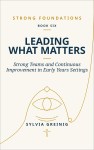
My book Leading What Matters: Strong Teams and Continuous Improvement in Early Years Settings is for leaders and managers who want to create safe, well-run settings where staff keep learning and growing, and where good practice is supported, shared and sustained. It’s Book Six in the Strong Foundations series.
Join Nursery Matters free to get Why Good People Stay: A Leader’s Quick To-Do List, ready to print as many copies as you need. Pin it up where you’ll see it, and tick off one small action at a time.

